February 26, 2021
One may as well begin with how I began to begin Howards End.
I was the loner in my high school. (I had also been the loner in my junior high.) Having no friends, I spent each lunch period by myself, sitting on the ground in the grassy space between two buildings full of classrooms. Sometimes happy chatter from groups of teenagers would waft out of a window, where I shivered on the cold days and perspired on the hot.
My position felt perilous. High school was a sea of strangers with unfathomable customs, bizarre costumes, and complex mating rituals. Other students seemed to enjoy the sea. They surfed and sailed and pleasure cruised, but I only drowned. Then I learned a book could be my life preserver.

After that, I never went anywhere without a book, and I even learned to walk and read at the same time. Looking back, I understand why books became my safe space. I didn’t like attending high school, but even more, I disliked other people’s perception of me as the one who did not fit in. It was humiliating.
When you’re reading a book, though, it’s like saying to everyone around you: You think you see me, but I am not really here. There is something happening inside this book and it is fascinating and important and wondrous. Your world does not matter. The person you see before you is merely a hologram. Where I truly live is inside this book. It’s better there, and there, you are the person who does not belong.
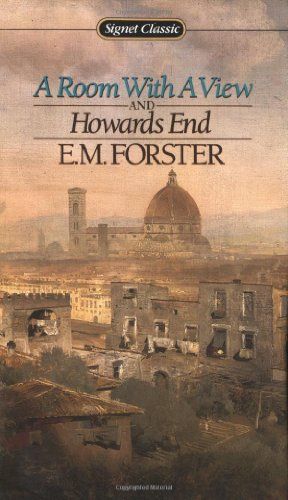
I remember the day I began to begin Howards End. It was a gray day, and I was sitting in that grassy in-between. This was the cover of my book.
I don’t know why I read Howards End first, rather than A Room With A View. Room certainly seems like it would have been more accessible to a fifteen-year old girl, and it’s got the blue title on the cover, while “Howards End” is graphic designed like the the B picture in a double-bill. Most likely, I had read another book that referenced Howards End. In those days I was trying hard to become more worldly, and reading books mentioned in other books was my chief strategy.
It was not because of the Academy Award-winning movie, because this was years before the 1992 Merchant-Ivory film, probably around 1988. My classmates were listening to INXS, Pet Shop Boys, REM, The Bangles. I was reading E.M. Forster and listening to Ella Fitzgerald. Not in a cool, “Hey, there’s a quirky square peg who’s really into jazz” way, either. More like in a “what the fuck is Tin Pan Alley and why is the loner weirdo talking to me about it?” way.
So I do know how I first began Howards End, but what I still don’t understand is why I never stopped beginning it. As soon as I finished Howards End in 1988, I read it again, and I’ve begun Howards End over and over again for the past thirty-three years. I’ve now read or listened to the novel at least fifty times, and still, something inside me knows I will begin it many times more. (Brief science Fiction interlude: maybe the day I stop beginning Howard’s End will be my end.) Most recently, I know for sure I listened to it about a year ago, because I remember hearing it through my Air Pods while I was washing groceries at the beginning of the quarantine.
Do I regret reading Howards End over and over? Certainly not. It gets better and more meaningful every time. In fact, each time I read it, I both understand the book more deeply and also recognize some new aspect of it which I don’t yet fully comprehend, and want to.
But why is it calling to me again now?
I just ended yet another relationship with a man. Perhaps there is something there. Forty-eight years old and all alone again, locked inside my house with a sullen sixteen-year old son. (I just realized he’s about the age I was when I first read Howards End. What habit has he begun, alone in his bedroom, that will stay with him for the rest of his life? (I mean besides that one.)) Maybe trying to think of Howards End in a linear sense isn’t right. Howards End is not something I should expect to either start or to finish. It’s unlike every other book because it’s a continuous processes. Howards End is a journey, not a destination. I always return to it because I know it contains questions to which I am curious to know the answers.
Come to think of it, Margaret and Helen Schlegel had the same experience with Howards End that I have had, repeatedly saying goodbye to it, then finding themselves drawn in again and again, and finally surrendering, resolving to spend the rest of their days in the place, or the “lodge,” as dear, silly, well-meaning Aunt Juley misrepresented it to the ticket boy:
“I want a house… It’s name is Howards Lodge. Do you know where it is?”
Aunt Juley Mundt, Chapter 3
The big question, I suppose, it what does Howards End mean? What does it symbolize, in the college freshman English Lit sense? For Helen and Margaret, but also for me? I have a lot of ideas about that, and also a few secret theories. (Hint: one of them has to do with the crusty and mysterious Miss Avery, her secret torrid love affair with Tom Howard, and their potential love child, who plays a critical part in the story.)
Howards End is the home you’re always drawn back to, whether or not it is your legal property. It’s a healthy, bucolic farm life of hay and magical pig’s teeth in wych elms, in opposition to the metropolitan soot of London, where one tastes pennies when one steps outside. It’s the last male member of a family named Howard, who was killed under unknown circumstances, taking with him the identity of the place as a farm, and leaving it an impossible country house, both too close and too far away from London.
Howard’s end is one of those converted farms. They don’t really do, spend what you will on them… The neighborhood’s getting suburban. Either be in London or out of it, I say.
Mr. Henry Wilcox, Chapter 15
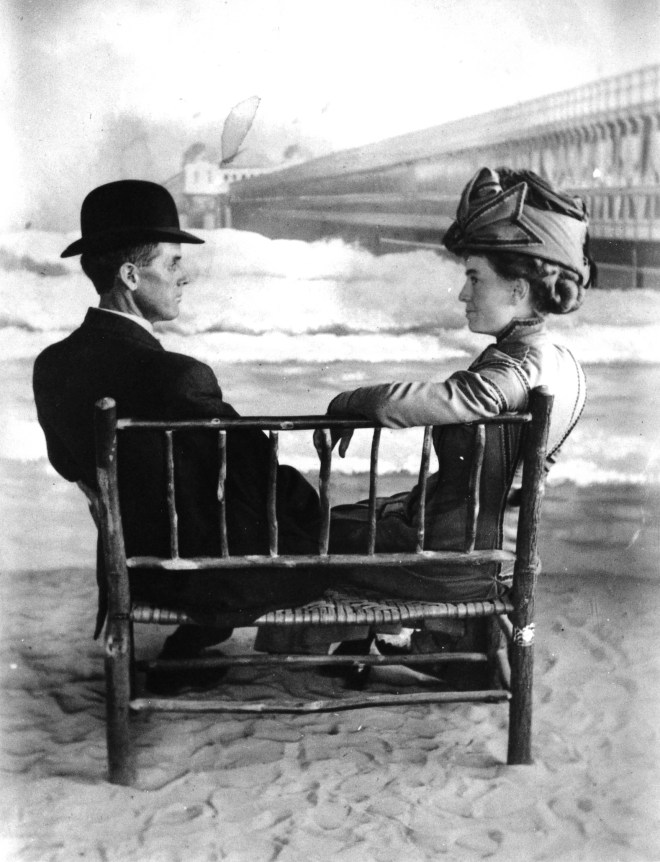
Is it possible old, obtuse Henry Wilcox was the one who put his finger on the meaning of Howards End? The place where you are never quite in, and never quite out? Surfing the wave, while knowing it is bound to crash, carrying you back to the shore, then diving back into the water and swimming out to sea again? It sounds like love. And also high school.
Why do surfers swim back out to sea? Something in the ocean is calling to them. Maybe Henry did understand Howards End, after all. Margaret Schlegel always believed in Henry, and I believe Margaret.
 Beginning Howards End